SPCX (SpaceX) Investment Analysis: Is the Space Empire with a $2.1 Trillion Market Cap Worth It?
SpaceX went public at a $1.77 trillion valuation, surging 19% on its debut and pushing its market cap to $2.1 trillion. Starlink accounts for 61% of revenue, Google has signed a $30 billion compute contract, and Starship is fully reusable — yet the company remains in the red. This article provides a full breakdown of SPCX's business model, financial data, and bull/bear thesis.
SpaceX: The Largest IPO in Human History
On June 12, 2026, SpaceX (NASDAQ: SPCX) listed on Nasdaq at $135/share, raising $75 billion at a valuation of $1.77 trillion. The stock closed up 19% on its debut day, hitting an intraday high of $176.52 and briefly pushing market cap to $2.1 trillion—surpassing Amazon to become the sixth-largest publicly listed company in the U.S.
On listing day, Musk became a "trillionaire" with a net worth exceeding one trillion dollars.
But beneath the euphoria, sober investors need to ask one question: why is a company that is still loss-making, with a P/S ratio near 100x, worth $2 trillion?

*Starlink satellites—SpaceX's core cash-flow engine, with 10.3 million subscribers worldwide.*
I. Business Model Breakdown
SpaceX's business can be split into three major segments, each targeting trillion-dollar markets:
1. Reusable Rocket Launch Business (Falcon / Starship)
This is SpaceX's "old business"—and the foundation of everything.
Revenue Sources:
- NASA government contracts: Crewed spaceflight (Crew Dragon), cargo resupply (Cargo Dragon), the Artemis moon-landing program
- Department of Defense contracts: Military satellite launches, Space Force missions
- Commercial satellite launches: Communication satellite operators such as OneWeb, SES, Intelsat
- Rideshare launches: A "bus ticket" model for small satellites and CubeSats
Core Moat—Full Reusability:
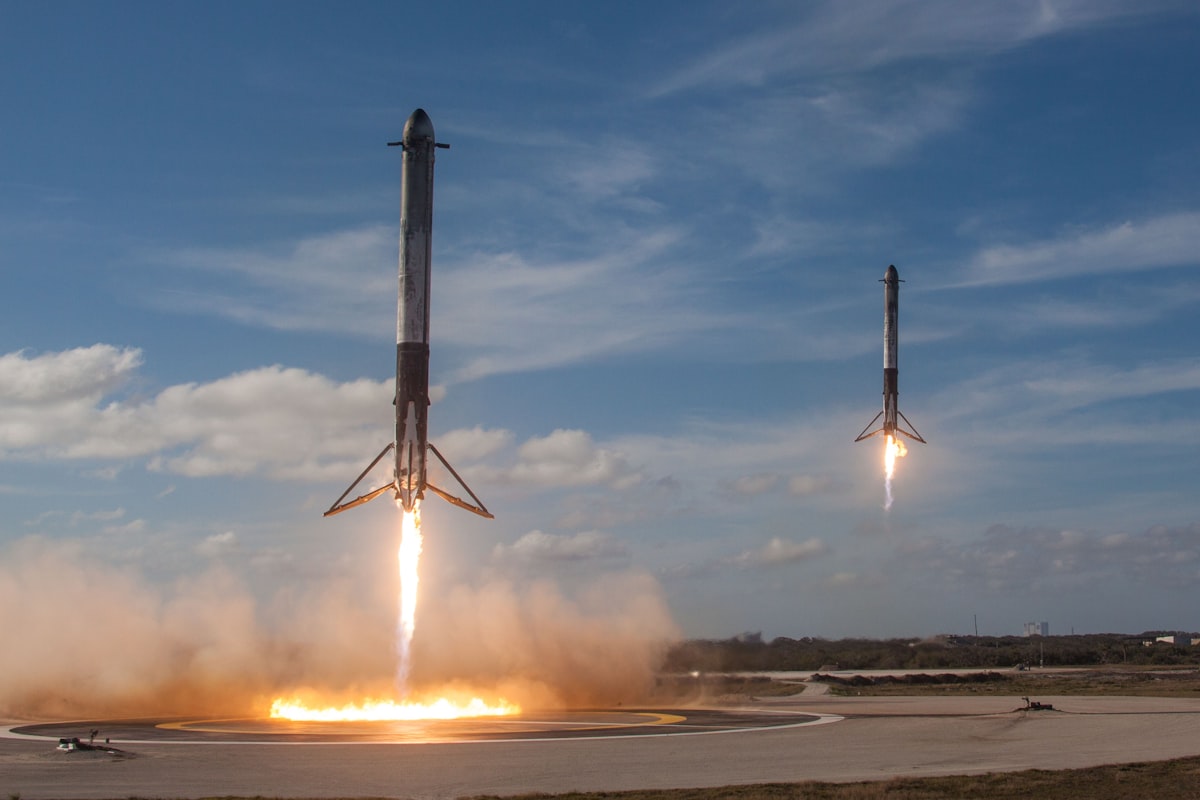
The Falcon 9 first stage can be recovered and reused more than 20 times, driving the marginal cost per launch from a traditional $200–300 million down to roughly $15–20 million (estimated internal cost of Falcon 9). Once Starship achieves full reusability, the theoretical marginal cost per launch could fall to $1–10 million—a 10–50x reduction versus traditional rockets.
Falcon 9's commercial price is $67–74 million per launch, while the estimated internal cost is only $15 million. This margin is the core profit source of SpaceX's launch business.
2025 Launch Business Data:
- Space segment revenue: $4.086 billion
- Operating loss: –$657 million (still investing in Starship development)
- Adjusted EBITDA: +$653 million (if R&D is excluded, the launch business itself is already close to profitability)
2. Starlink Satellite Internet (Consumer + Enterprise)
Starlink is SpaceX's growth engine—and has already become its largest revenue source.
Revenue Sources:
- Consumer subscriptions: Residential broadband ($80–120/month), RV/maritime ($135–250/month), global roaming
- Enterprise services: In-flight Wi-Fi (Delta, United), maritime (cruise ships, cargo vessels)
- Government/military: Battlefield applications in Ukraine, Starshield defense variant
- Direct-to-Cell: Beginning in 2026, partnerships with operators such as T-Mobile
Key Data:
| Metric | Value |
|---|---|
| 2025 Starlink revenue | $11.4 billion (61% of total revenue) |
| Global subscribers | 10.3 million (as of March 2026) |
| ARPU (average monthly revenue per user) | roughly $90–110 |
| Satellites in orbit | over 7,000 |
| Countries/regions covered | 100+ |
Industry Moat: Low-Earth-orbit satellite internet is a winner-take-all market—launch enough satellites first and you lock in the spectrum and orbital slots, making it nearly impossible for latecomers to catch up. SpaceX's 7,000+ satellites have already built a moat that is extremely difficult to cross.
3. Space Compute Infrastructure (xAI + Data Centers)
This is the third growth curve that SpaceX only revealed on the eve of its IPO—and it's the part that has the market most excited.
Model: SpaceX leverages its launch capability to deploy space-based data centers and ground-based GPU clusters at scale, providing compute services to AI companies.
Major Contracts:
- Google $30 billion compute contract (signed June 2026): Google is renting roughly 110,000 NVIDIA GPUs plus CPUs and networking equipment from SpaceX, starting October 2026, with the contract running through June 2029
- Anthropic compute agreement: Using the full compute capacity of SpaceX's Colossus 1 data center
- xAI (Musk-affiliated): Grok model training relies on SpaceX compute infrastructure
This segment means SpaceX is no longer just a "rocket company"—it is a "space + AI infrastructure company." The market's valuation logic is completely different here—if you value it like an AI compute company on P/S, $2 trillion suddenly doesn't look that expensive.
II. Current Fundamentals
2025 Full-Year Financial Summary
| Metric | 2025 | 2024 | Change |
|---|---|---|---|
| Total revenue | $18.7B | $13.1B | +33% |
| ├ Starlink | $11.4B (61%) | ~$8.0B | +43% |
| ├ Space (launch) | $4.09B (22%) | ~$3.5B | +17% |
| └ Other (incl. compute) | $3.21B (17%) | ~$1.6B | +100% |
| Operating loss | Still loss-making (narrowing) | Large loss | Improving |
| 2026 Q1 revenue | YoY +15% | — | Continued growth |
Valuation (Post-IPO)

*The valuation debate after SPCX's listing—is it the dawn of the space age, or another bubble?*
| Valuation metric | Value | Interpretation |
|---|---|---|
| IPO valuation | $1.77T | Largest IPO in history |
| Closing-day market cap | ~$2.1T | Sixth-largest U.S. public company |
| P/S (2025 revenue) | ~94x | Extremely high (NASA peers ~3–5x) |
| P/S (2026 expected) | ~73x | Expected revenue $22–24B |
| Fair Value (FutureSearch) | ~$1.25T | ~29% below current price |
| Analyst price target | $161 (at close) | Sharp near-term divergence |
Musk's $1 Trillion Revenue Prediction
After the listing, Musk publicly stated: SpaceX's annual revenue could reach $1 trillion by 2030.
Versus $18.7 billion in 2025, this means 5.3x growth in five years—a compound annual growth rate of roughly 40%. Is it possible?
- Starlink users grow from 10.3 million to 100 million+ → with stable ARPU = $120B/year
- Compute contracts continue to expand (the Google $30B deal is just the start)
- Starship enables large-scale commercial cargo + space tourism
This is an extremely aggressive forecast. But if SpaceX actually achieves $1 trillion in revenue, the P/S on a $2 trillion market cap would be only 2x—extremely reasonable. The question is: do you believe this forecast?
III. Bull vs. Bear Case
🟢 Core Bull Logic
1. Starlink's Global Dominance
Low-orbit satellite internet has limited spectrum and orbital resources. SpaceX has already launched 7,000+ satellites, while Amazon Kuiper has launched only a few dozen. Closing that gap would take at least 5–8 years. Starlink has already built an irreplaceable position in remote regions, aviation, maritime, and military applications.
2. Full Starship Reusability = Launch Costs Collapse
If Starship achieves full reusability (both first and second stages recoverable), launch cost could fall to $1–10 million per launch. This would fundamentally rewrite the economics of spaceflight—satellite launch costs becoming negligible, Starlink deployment costs falling sharply, and space tourism and asteroid mining becoming viable.
3. Google's $30B Compute Contract Validates the Third Curve
This contract proves that SpaceX's compute business is not just a concept but real, paid revenue. Starting October 2026, it could contribute $8–10 billion per year—equivalent to instantly adding another "Space launch" segment-sized business.
4. Long-Term Stability of Government Space Contracts
NASA Artemis, Department of Defense Space Force contracts, European Space Agency collaborations—these are all 10–20 year long-term orders, unaffected by the economic cycle.
5. The Mars Long Game
It sounds like science fiction, but Musk is serious. If crewed Mars landings are achieved in the 2030s, SpaceX will become the only "interplanetary infrastructure company" in human history—the upside here is incalculable.
🔴 Core Investment Risks
1. Persistent Heavy Losses
Since its founding in 2002, SpaceX has lost money in nearly every year. In 2025, while revenue grew 33%, operating income remained negative. Starship R&D, continuous Starlink satellite production and replacement, and data center construction are all money-burning machines.
2. Extremely High Valuation Already Prices in Future Growth
A 94x P/S implies the market has already priced in 5–7 years of rapid growth. If growth falls short—even just "growth slowdown" rather than "contraction"—the stock could face a meaningful pullback. FutureSearch's SOTP valuation shows fair value around $1.25 trillion, roughly 29% below current levels.
3. Regulation Frequently Constrains Starlink Operations
- China, Russia, and many other countries ban or restrict Starlink service
- U.S. FCC uncertainty around satellite spectrum allocation
- Entry negotiations delayed in emerging markets such as India
- Environmental groups filing complaints about astronomical observation impact from excessive satellite numbers
4. Heavy Dependence on Musk Personally
SpaceX = Musk. His vision, decisions, and public image directly affect the company. If Musk—due to health, legal issues, or distractions from his other companies (Tesla, xAI, Twitter/X)—reduces his involvement with SpaceX, the company's execution will be called into question. Key Person Risk is amplified to the extreme at SpaceX.
5. Persistent Large Capital Needs
- Starship development: $3–5B per year
- Starlink satellite ongoing production + launches: $5–8B per year
- Data center GPU procurement: the Google contract requires massive upfront investment
- Mars program R&D: a long-term cash sink
SpaceX may need to keep raising capital. Although the IPO raised $75 billion, if cash burn continues at this pace, additional financing could be needed within 3–5 years—potentially through debt or follow-on offerings, diluting existing shareholders.
6. Rising Competition
- Amazon Kuiper: Behind, but Bezos has unlimited capital
- Rocket Lab: Small reusable rockets already commercialized
- Blue Origin: New Glenn + lunar lander
- Traditional aerospace giants: ULA, Airbus, and Boeing won't give up easily
IV. Overall Investment Judgment
Short-Term Speculation (1–3 months): ⚠️ High Risk, Not Recommended to Chase
| Factor | Assessment |
|---|---|
| IPO frenzy | Up +19% on day one but has given back some gains; short-term sentiment cooling |
| Lockup pressure | Insider lockup expires within 180 days post-IPO; potential selling ahead |
| Market environment | FOMC rate uncertainty + triple-witching-day volatility |
| Technicals | Range-bound between $135–176, no clear direction |
Short-term approach: Best to avoid the post-IPO volatility period. If you must participate, wait for a pullback into the $140–150 zone with a small position, and set a stop at $130 (exit if price breaks below the IPO price).
Long-Term Value Position (1–3 years): ✅ Build in Tranches, But Control Sizing
SPCX has a strong long-term thesis, but the valuation is very high:
| Scenario | Probability | Price target |
|---|---|---|
| Bull — Starship reusability succeeds + compute boom + Starlink hits 50M users | 30% | $250–300 |
| Base — Growth on track, $50B revenue by 2028 | 50% | $180–220 |
| Bear — Starship delays + competition intensifies + growth slows | 20% | $90–120 |
Long-term approach:
- Aggressive investors: Build a position in 3 tranches (30%/30%/40%) between $150–165, target $250+, stop at $120
- Conservative investors: Wait until 6 months post-IPO after the lockup wave and the first earnings report confirms the growth trend before entering
- Not suitable for: Investors seeking stable dividends, investors with low tolerance for volatility, investors with no understanding of the space industry
Key Indicators to Watch
| Indicator | What to watch | Why it matters |
|---|---|---|
| Starlink user growth | Quarterly net subscriber additions | Core driver of revenue growth |
| Starship reusability progress | Whether second-stage recovery is achieved | Key milestone for the cost revolution |
| Compute contract expansion | New clients beyond Google | Sustainability of the third curve |
| Operating loss narrowing | Quarterly operating margin trend | Progress toward profitability |
| Musk's shareholding changes | Insider selling activity | Confidence signal |
| Kuiper / Blue Origin progress | Competitor launch cadence | Width of the moat |
Conclusion: Space Casino vs. Space Empire
SPCX is the most controversial IPO of 2026—without question.
Bulls see: the world's only fully reusable rocket company + satellite internet monopolist + AI compute newcomer + Mars dream—a combination unique in human history.
Bears see: P/S 94x + persistent losses + Key Person Risk + upfront costs of a $30B compute contract + likely future financing—a valuation that has already priced in the best-case scenario for the next five years.
My judgment: SPCX is worth watching, but not worth overweighting. Allocate 3–5% of your portfolio to this "space lottery ticket"—enough to enjoy the upside surprise, but not enough to break the bank on a drawdown.
Space is the final frontier. SpaceX is building the highway to that frontier. The only question is: when does the toll road start collecting, and how much?
⚠️ Disclaimer: This article is for educational purposes only and does not constitute investment advice. Investing involves risk.
🎯 Quick Quiz
Finished reading? Test what you remember
Question 1/5
What market cap milestone did SpaceX briefly touch on its June 12, 2026 listing day?
✗ Incorrect
Your answer:—
Correct answer:B. $2.1 trillion, surpassing Amazon as the sixth-largest U.S. public company
💡 The article states the stock closed up 19% on debut day, hitting an intraday high that 'briefly pushing market cap to $2.1 trillion—surpassing Amazon to become the sixth-largest publicly listed company in the U.S.'