DELL Explained: How the PC King Became an AI Infrastructure Darling
Dell has evolved from a PC brand into a key AI server vendor riding the hyperscaler capex wave. This article breaks down Dell's business mix, the logic behind the recent push to $500, competitive risks against SMCI and HPE, and what investors should watch.
DELL Explained: How the PC King Became an AI Infrastructure Darling
If you still think Dell is just the brand that sells PCs bundled with Office, you've been out of the loop for a while. Since the AI boom kicked off, Dell has quietly become one of the arms dealers behind the hyperscaler build-out. This article walks you through what Dell actually does, why the stock just pushed to $500, and where the risks sit — in plain English.
What Is Dell?
Dell Technologies (NYSE: DELL) was founded by Michael Dell in his dorm room back in 1984. The company went private in 2013, then re-listed on the public markets in 2018. After a long stretch of acquisitions and restructurings, today's Dell is essentially a two-leg business:
- CSG (Client Solutions Group) — Dell's traditional core: PCs, laptops, and workstations. Think XPS, Latitude, and Alienware. This is the largest segment by revenue, but margins are thin and the business is cyclical, tracking the global PC market.
- ISG (Infrastructure Solutions Group) — This is the leg that turned Dell into an AI stock. ISG sells servers, storage, and networking gear to enterprises and cloud providers. It includes AI training servers like the PowerEdge XE series and PowerStore storage arrays.
Dell also held a majority stake in VMware, which was spun off into an independent public company at the end of 2023. Dell still owns roughly 40% of VMware, and the spin-off delivered a giant cash payout that Dell has been using to pay down debt — a major tailwind for the balance sheet.
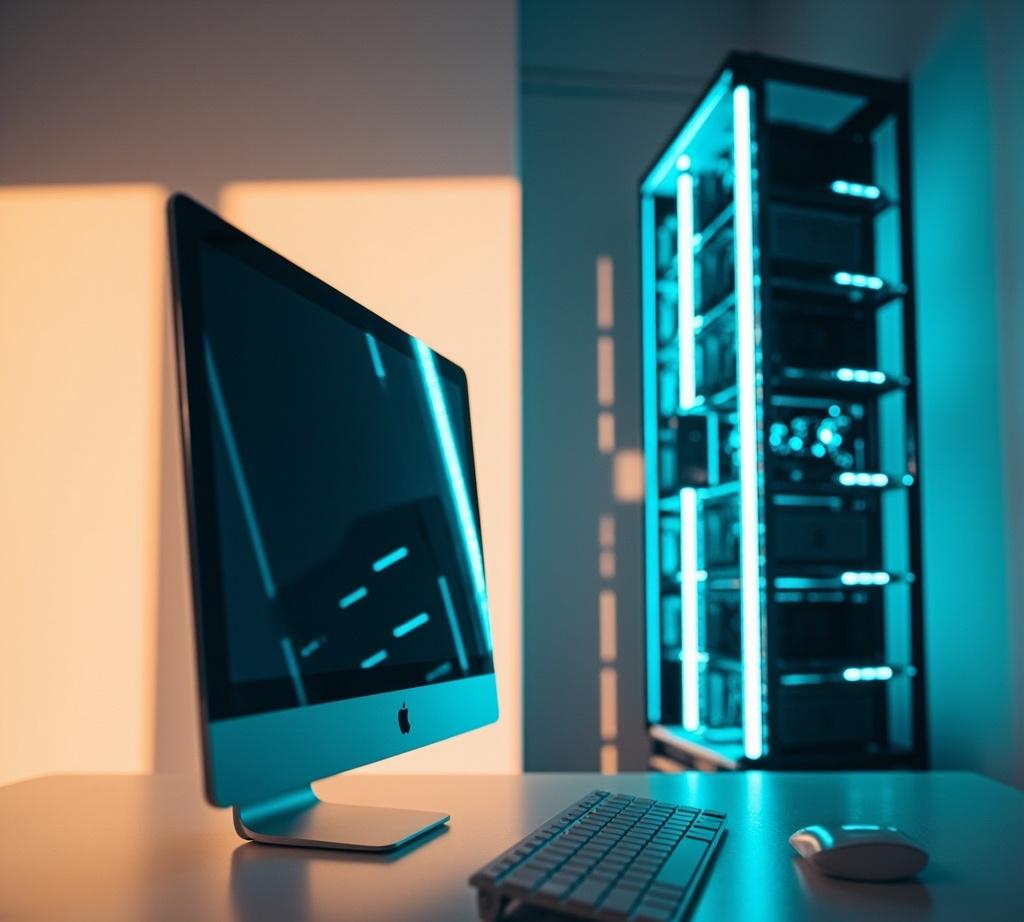
In short: today's Dell is a PC business + an AI server business walking on two legs. PCs are stable but slow; AI servers are the engine that has driven the recent rally.
The AI Boom: Dell's Second Leg
Dell's biggest value in the AI era comes from being NVIDIA's system integrator and rack-scale assembler. A reasonable question: why would hyperscalers buy from Dell instead of ordering GPUs directly from NVIDIA?
- Rack-scale solutions — Dell's PowerEdge XE9680, paired with NVIDIA H100/H200/B100 GPUs, ships as a full rack with liquid cooling, networking, and power management pre-tuned. Hyperscalers can plug it in and start training.
- GB200 NVL72 systems — Dell is one of NVIDIA's main partners helping hyperscalers deploy "AI factory"-grade NVIDIA reference designs.
- Channel and after-sales — Dell's enterprise service network lets it deliver full-stack upgrades to any company rolling out an AI cluster. That's a moat pure-play GPU vendors can't easily replicate.
This is the classic picks-and-shovels logic for Dell. It doesn't matter which AI application wins — ChatGPT, Claude, or Gemini — every training run needs racks like Dell's, and demand is exploding. Dell's CFO has publicly noted that AI orders backlog has already crossed several billion dollars.
The Recent Rally: Why $470 Broke to $500
Looking at recent trader signals and news, DELL's surge can be framed around two key price levels:
First trigger: the $470 breakout — Before early August, DELL was grinding sideways around $420. Once it cleared $470 resistance, the move was confirmed, and momentum traders piled in. Using $480/$490/$497.5 weekly calls, the trade captured big moves — Discord-signal records show $480 weekly calls returning +170%, $490 weekly calls returning +180%. Classic trend-following after a confirmed breakout.
Second trigger: the $500 psychological level — Once DELL pushed above $500, the community split. Some traders took profits (the $520 weekly calls ended up -49%), while others believed the AI story was far from over and were looking for $530 or $550 next.
That's exactly what DELL is: not a faith stock like NVDA, but a momentum stock that swings with AI capex cycles, macro conditions, and institutional flows. Technical breakout + AI tailwind = tailwind. The moment either weakens, it's time to take chips off the table.
Risks: The Gold Rush Is Getting Crowded
- SMCI's double-edged boost — Super Micro Computer's blowout quarter (FY27 revenue guidance of $65-72B, backlog over $60B) lifted the entire AI server basket, and DELL was a clear beneficiary. But the stronger SMCI gets, the more it could pressure DELL's share.
- ODM (white-box) squeeze — Quanta, Wiwynn, and Foxconn directly serve hyperscalers and compress margins. DELL's ISG margins have historically been modest, and while AI racks are seen as better-margin, OEMs risk being reduced to assemblers once NVIDIA pushes more standardized reference designs.
- PC business cycle — PCs are a mature, cyclical industry. AI-PC is still mostly a marketing story and won't show up in revenue immediately. Global PC demand remains soft, so CSG won't drive a near-term upside surprise.
- Valuation risk — DELL has rallied hard over the past year, and forward P/E sits near historical highs. Any slowdown in AI capex growth or a sharper macro turn could trigger a meaningful drawdown.
- Options liquidity trap — DELL's weekly options are very active, but implied volatility is also high. Buying calls carries a steep vol premium that eats into real returns.
What Should Investors Watch?
If you want a "relatively stable AI concept stock," DELL is arguably more diversified than SMCI, with a longer history, multiple revenue streams, and steadier cash flow. But keep these points in mind:
- Core holders — Watch ISG growth rate, AI server order pipeline, and CSG EBITDA. As long as AI orders grow 20%+ quarter-over-quarter, the thesis holds. If growth slows, it's time to re-evaluate.
- Tactical traders — Wait for pullbacks into the $460-$480 zone before considering new positions. Don't chase above $500; the call premium and gamma risk are too high.
- Stop-loss discipline — DELL's beta is not low, and the stock is volatile. Set clear stops and don't let "AI faith" override your risk management.
A final reminder: this article is for information and logical breakdown only, not a buy or sell recommendation. Investing involves risk, so size positions according to your own risk tolerance and do your own homework.
⚠️ Disclaimer: This article is for educational purposes only and does not constitute investment advice. Investing involves risk.
🎯 Quick Quiz
Finished reading? Test what you remember
Question 1/5
According to the article, what are Dell's two main business segments today?
✗ Incorrect
Your answer:—
Correct answer:A. CSG (Client Solutions Group) and ISG (Infrastructure Solutions Group)
💡 The article explicitly states Dell is a 'two-leg business': CSG (PCs, laptops, workstations like XPS, Latitude, Alienware) and ISG (servers, storage, networking for enterprises and cloud providers, including AI training servers).