ALAB Explained: The Hidden Chip Star Behind AI Compute
Astera Labs (ALAB) is a leader in rack-scale connectivity chips for AI infrastructure, posting record Q2 2026 revenue of $392.4 million, up 104% year-over-year. This article breaks down its business, technology, valuation and key risks for investors.
ALAB Explained: The Hidden Chip Star Behind AI Compute
If you were to pick the most underappreciated name in the AI supply chain over the past two years, Astera Labs (NASDAQ: ALAB) would be high on the list. It is not as famous as Nvidia, nor as well known as Broadcom, but virtually every AI server used to train large language models contains its chips working quietly in the background. For investors who want to understand the full picture of AI infrastructure, ALAB is impossible to ignore.
1. What exactly does ALAB do?
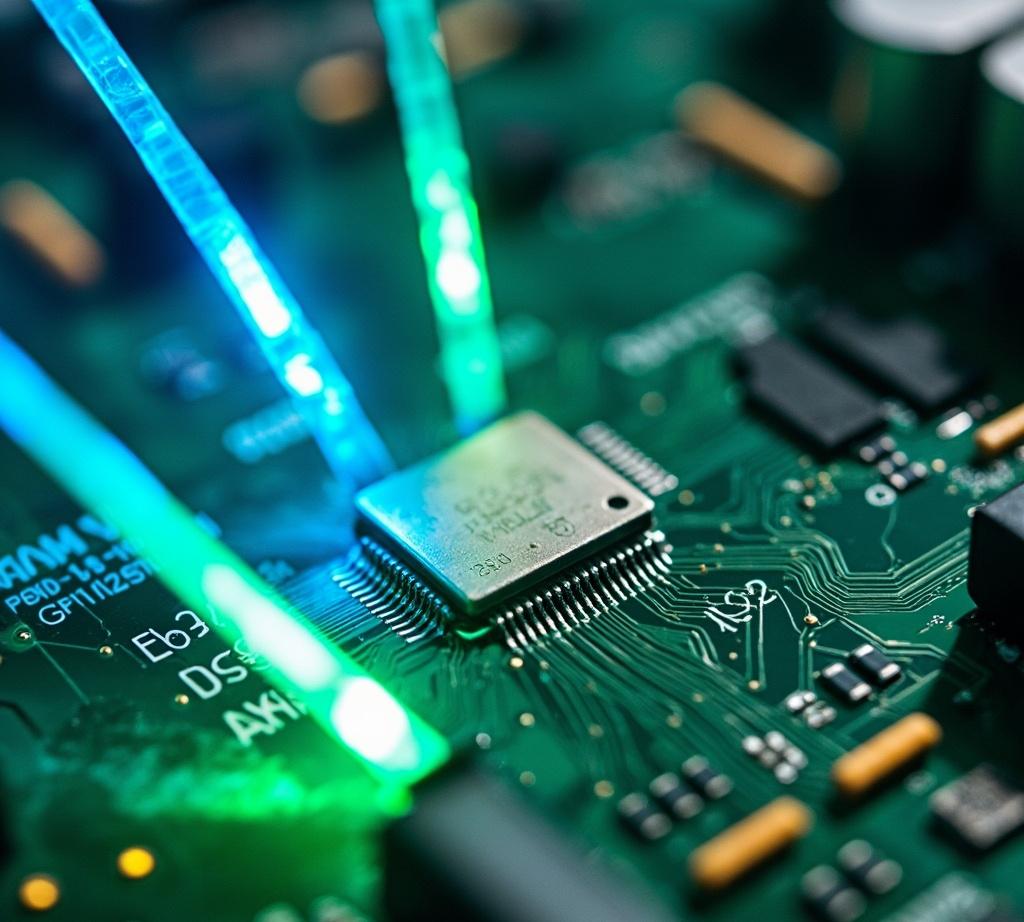
In simple terms, Astera Labs designs rack-scale connectivity chips. Rack-scale means the company does not look at a single GPU or a single server, but instead treats an entire data center rack as one supercomputer.
In such an architecture, how data moves between GPUs, CPUs, memory and storage becomes the bottleneck. Traditional PCIe lanes and copper cables are reaching their physical limits when AI training demands TB/s-level bandwidth, which is exactly where ALAB steps in. It offers three core product families:
- Aries: chip-to-chip and board-level PCIe/CXL connectivity solutions, the company's founding product;
- Taurus: smart NICs and controllers for memory pooling;
- Leo / Scorpio: optical communications transceivers and retimer chips designed for AI racks, currently the fastest-growing product line.
In other words, ALAB does not produce GPUs nor complete switches, but the components it sells determine whether an entire AI factory can run smoothly.
2. What did the latest earnings report say?
ALAB's Q2 FY2026 results, released in August 2026, can be described in one word: stunning. Quarterly consolidated revenue reached $392.4 million, up 27% QoQ and 104% YoY, setting a new all-time high. On the profitability side, Non-GAAP gross margin stayed above 70%, and Non-GAAP EPS comfortably beat market consensus.
More importantly, the company raised its Q3 revenue guidance substantially, signaling management's strong confidence in H2 AI demand. Three key drivers stand behind this:
- Scaling of AI training clusters: hyperscalers continue to build GPU clusters at the 10,000- or even 100,000-card level, and every node requires high-speed interconnect;
- Rising optical penetration: copper cables are approaching their physical limits, making optical modules and retimer chips the mainstream choice; ALAB's Scorpio series is right in the middle of this wave;
- Supply chain reshuffle: against the backdrop of potential import restrictions on some foreign optical modules, ALAB, with design and production capacity in the US and Taiwan, is viewed as a relatively favored domestic alternative.
3. Is the valuation too expensive?
This is the hardest question for ALAB investors. As of late August 2026, the stock is trading in the $280–$290 range, while the 52-week range stretches from $97.89 to $499.48. That range alone tells you how divided the market is.
From a fundamentals perspective, the forward 12-month P/E is still above 60x, well above the semiconductor sector median. But if you frame it as "100%+ revenue growth with 70% gross margins," traditional valuation models start to look conservative. The average analyst price target sits around $272, while more aggressive houses see ALAB heading toward $1,000 if Scorpio X ramps successfully.
The underlying debate is essentially: is AI compute a cyclical bubble, or a new decade-long infrastructure cycle? Both bulls and bears have strong arguments.
4. Key risks to watch
However strong the narrative, the risks cannot be ignored. Before investing in ALAB, at least put the following three factors into your decision model:
- Extreme valuation volatility: a 4x gap between the 52-week low and high means that if the AI narrative weakens, the drawdown can be severe;
- Insider selling signal: recently, the company's General Counsel and President & COO both made million-dollar stock sales. Insider selling is not automatically bearish, but at elevated valuations the market tends to amplify such signals;
- Customer concentration: revenue is heavily concentrated in a small number of hyperscalers. If any of them slows capex or accelerates in-house silicon programs (such as custom NICs), ALAB's order book could come under pressure.
5. A framework for general investors
Instead of asking "should I buy ALAB right now," it is more useful to step back to three foundational questions:
- Do you believe AI infrastructure spending will stay intense for another 3–5 years? If yes, ALAB as a critical interconnect supplier still has long-term tailwinds.
- Can you tolerate a possible 50% drawdown in the short term? At this valuation and volatility, position sizing and staggered entries are more rational than going all-in.
- Do you have alternative names? Broadcom, Marvell, Coherent (optical communications) and Credo are all peers or upstream/downstream partners of ALAB, and a basket approach helps diversify single-stock risk.
Closing thoughts
ALAB is not a stock "for everyone," but it is one of the purest windows into the underlying logic of AI compute. For investors who want to understand this compute revolution in depth, spending time on its product roadmap, customer mix and supply chain position will teach you far more than staring at the candlestick chart. The stock may continue to be volatile in the near term, but over the longer run, the company illustrates one thing clearly: the AI race is not just a GPU war, it is a war over "how to connect the GPUs"—and ALAB stands on that invisible superhighway.
⚠️ Disclaimer: This article is for educational purposes only and does not constitute investment advice. Investing involves risk.
🎯 Quick Quiz
Finished reading? Test what you remember
Question 1/5
What does Astera Labs (ALAB) primarily design and sell?
✗ Incorrect
Your answer:—
Correct answer:B. Rack-scale connectivity chips for AI infrastructure
💡 The article states that ALAB 'designs rack-scale connectivity chips' and 'does not produce GPUs nor complete switches,' instead making components that determine whether an AI factory runs smoothly.