The Mathematical Truth About Martingale Strategy: Why It Is Doomed to Bankruptcy
The Martingale strategy (doubling bets after losses) guarantees recovery in theory, but guarantees bankruptcy in reality. This article uses mathematics to prove why Martingale is destined to fail, and compares the risks across three types of EAs.
What Is the Martingale Strategy?
The core logic of the Martingale strategy: after every loss, double the size of your next position, hoping one win will recover all previous losses.
Sounds reasonable? Let's look at it with math.
A Simple Math Walkthrough
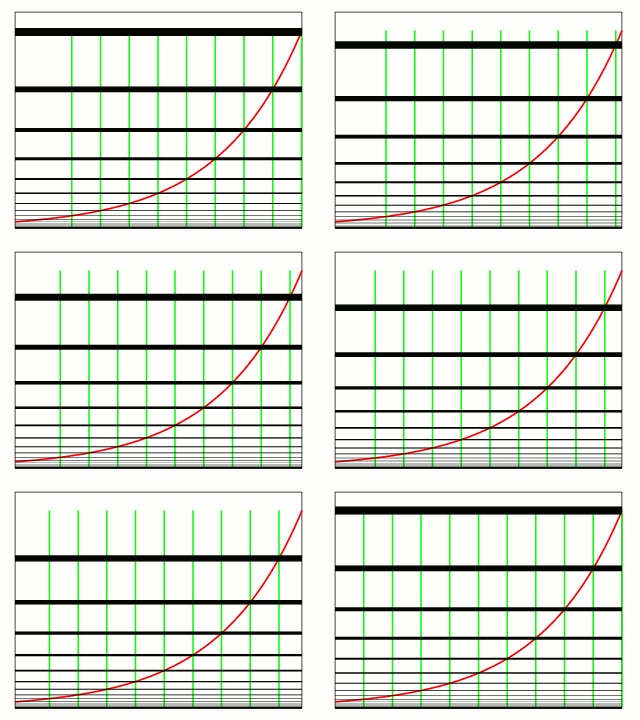
*Growth animation — Martingale position sizes spiral out of control after just 8 doublings.*
Suppose you start at 0.01 lots and double after every loss:
| Consecutive Losses | Position (lots) | Cumulative Loss (USD) |
|---|---|---|
| 1 | 0.01 | ~10 |
| 2 | 0.02 | ~30 |
| 3 | 0.04 | ~70 |
| 4 | 0.08 | ~150 |
| 5 | 0.16 | ~310 |
| 6 | 0.32 | ~630 |
| 7 | 0.64 | ~1,270 |
| 8 | 1.28 | ~2,550 |
| 9 | 2.56 | ~5,110 |
| 10 | 5.12 | ~10,230 |
After just 10 consecutive losses, you'd need to trade 5.12 lots (5,120 ounces of gold) for a chance to break even. With gold moving 10 USD, that position alone swings $5,120 in profit or loss.
Conclusion: with limited capital, the Martingale strategy has only one expected outcome — ruin.
Why Does It "Work" in Theory?
The theoretical foundation of Martingale is this: given infinite capital and infinite time, you will eventually win once. But in reality:
- Capital is finite: your account is not infinitely large
- Time is finite: the market only trades during certain hours
- Brokers cap position size: most brokers limit the maximum size of a single trade
- Spread accumulates: every trade carries a cost, so doubling doesn't mean profit doubles cleanly
Risk Comparison Across Three EA Types
| EA Type | Win Rate | Max Loss Per Trade | Blow-Up Risk |
|---|---|---|---|
| Trend Following | 30–40% | Fixed (stop-loss set) | Low |
| Grid | 60–70% | Uncertain (may keep adding to losers) | Medium |
| Martingale | 90%+ (until it blows up) | Exponential growth | Extreme |
Martingale EAs' "high win rate" is an illusion: they can win hundreds of times in a row before blowing up, but a single blow-up wipes out all the profits and the original capital.
Martingale Disasters in the Gold Market
Gold's daily range is typically 15–30 USD, and can reach 50–100 USD in extreme conditions. That means:
- A 30-USD stop-loss on 0.01 lots = $0.30 loss
- But a 30-USD stop-loss on 1.28 lots after 8 doublings = $38.40 loss
- A 30-USD stop-loss on 5.12 lots at the 10th level = $153.60 loss
And it's not uncommon for gold to print 10 consecutive candles in the same direction — especially on major data days like Non-Farm Payrolls or CPI.
The Right Money Management Alternatives
Instead of "gambling to break even" with Martingale, try this instead:
- Fixed risk percentage: risk no more than 1–2% of your account on any single trade
- Fixed position size: always trade the same number of lots
- Pyramid into winners: only add to a position that's already in profit, never one that's losing
- Kelly Criterion: calculate the optimal position size based on win rate and risk-reward
Chapter Recap
Martingale is one of the biggest traps in the trading world. Its "high win rate" only delays ruin — it doesn't prevent it.
"Martingale isn't a strategy. It's gambling."
If you're currently running a Martingale EA, stop it immediately. Replacing it with fixed risk percentages is the only path to long-term survival.
⚠️ Disclaimer: This article is for educational purposes only and does not constitute investment advice. Investing involves risk.
🎯 Quick Quiz
Finished reading? Test what you remember
Question 1/5
According to the article, what is the core logic of the Martingale strategy?
✗ Incorrect
Your answer:—
Correct answer:A. Double the size of the next position after every loss, hoping one win will recover all previous losses
💡 The article explicitly defines the Martingale core logic as doubling position size after every loss in hopes that one winning trade recovers all prior losses.